New Texas Social Studies Framework Integrates Biblical Literacy and Traditional History Standards
The Texas State Board of Education adopts new social studies standards incorporating biblical curriculum elements into public school requirements.
Editorial disclaimer: Opinions and analysis on Keep TX Red are editorial content — not statements of fact. See our editorial standards.
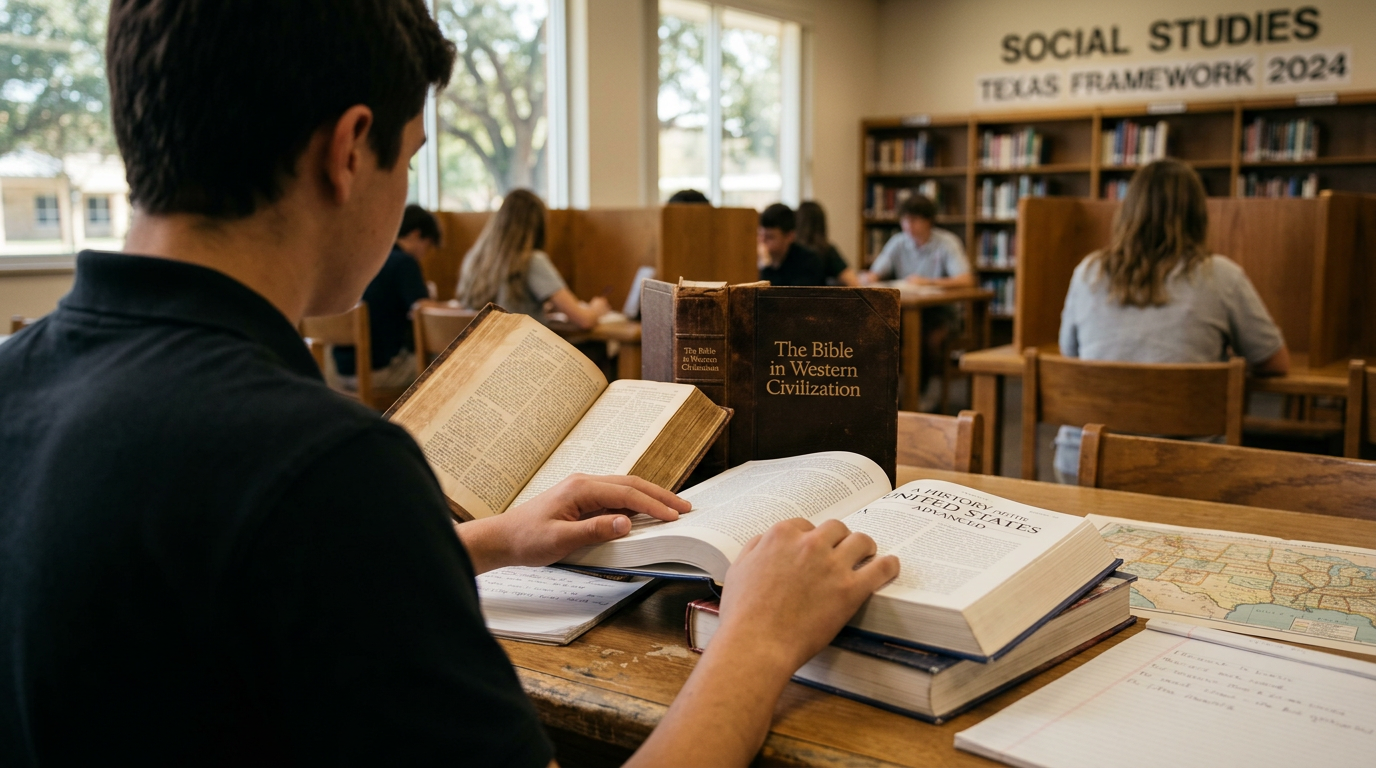
In a definitive move to reshape the academic landscape of the Lone Star State, the Texas State Board of Education (SBOE) has officially greenlit a revised set of social studies standards that place an increased emphasis on biblical literature and Christian historical themes. This decision follows months of rigorous debate between educators, parents, and policymakers regarding the proper role of religious texts in a public school setting. The update is designed to weave specific religious narratives into the broader tapestry of Western civilization and American foundational history, ensuring that students understand the cultural and religious roots that informed many of the nation's early legal and social structures. Historically, Texas has been a trendsetter in curriculum development, often influencing textbook publishers nationwide due to its massive market share. This latest shift continues that tradition of self-directed educational policy. Historically, Texas curriculum changes have been a battleground for defining the state’s identity. From the mid-20th century to the present, the SBOE has frequently pivoted toward a more traditionalist view of American exceptionalism and the importance of civic responsibility. Earlier iterations of the social studies standards have faced criticism for either being too Eurocentric or, conversely, for omitting crucial historical figures depending on the political makeup of the board at the time. This current update represents a clear consolidation of influence by the board's more conservative members, who argue that removing religious context from history is an act of omission that prevents students from fully grasping the motivations of the Founding Fathers and the development of the American democratic experiment.
Texas relevance
Texas serves as the primary epicenter for this shift, as the SBOE's decisions directly dictate the instructional materials used by millions of students across the state. In cities from Houston to El Paso, the implementation of these standards will require local districts to review and potentially replace current social studies curricula to align with the state's new benchmarks. The move is particularly significant in Texas, where the intersection of faith and public policy remains a central pillar of the state's political culture. Local school board elections are expected to see increased engagement as communities discuss how these state-level mandates will be applied in their specific classrooms.
The Integration of Biblical Texts into Core Instruction
The core of the new standards involves the specific inclusion of biblical parables and historical narratives within the social studies framework. This is not intended as a devotional exercise but rather as a study of the Bible's influence on Western literature, law, and morality. Students will be expected to identify how various Judeo-Christian concepts influenced the development of the Magna Carta, the Declaration of Independence, and the U.S. Bill of Rights.
The board has structured these requirements to span multiple grade levels, beginning with foundational stories in elementary school and progressing to more complex philosophical analyses in high school government and history courses. The objective is to provide a cohesive narrative that links antiquity with modern American governance, highlighting the specific religious ethics that supported the rise of individual liberty and representative democracy in the Western world.
Legislative Support and Policy Alignment
This move by the State Board of Education coincides with a broader legislative trend in Austin toward school transparency and parental rights. Several recent bills in the Texas Legislature have sought to give parents more control over the materials their children encounter in the classroom. The SBOE’s new standards are seen by many as the administrative fulfillment of these legislative goals, bridging the gap between state law and classroom instruction.
Furthermore, the alignment of these standards indicates a high level of coordination between the executive branch and education officials. Governor Greg Abbott and other state leaders have frequently voiced support for a curriculum that prioritizes 'patriotic education.' By integrating biblical themes, the SBOE is providing a framework that supporters believe will instill a deeper sense of appreciation for the unique historical path taken by the United States and the State of Texas.
Impact on Textbook Publishers and Local Districts
Texas is one of the largest purchasers of textbooks in the country, which means that the standards adopted here often become the default for publishers aiming for the national market. When the SBOE mandates specific content, companies like Pearson or McGraw-Hill often adjust their national editions to match the Texas requirements to ensure profitability. This gives the Texas board a reach that extends far beyond the state’s borders, influencing what students in other states might learn.
At the local level, the 1,200+ school districts in Texas must now determine how to execute these mandates. While the state provides the standards (TEKS), the actual lesson plans are often developed by local administrators. This creates a secondary layer of debate, as school boards in more urbanized or progressive districts may seek ways to meet the letter of the law while maintaining a more pluralistic approach to their history offerings. The tension between state mandates and local control remains a defining characteristic of the Texas education system.
Historical Precedent and the Evolution of the TEKS
The Texas Essential Knowledge and Skills (TEKS) have undergone several major revisions over the last two decades. In the early 2010s, the board made headlines for emphasizing the roles of figures like Moses and Thomas Aquinas in the development of Western law. The current revision represents a expansion of that previous work, moving from brief mentions to more robust, integrated study. This evolution suggests a long-term strategy by conservative education advocates to slowly move the needle toward a more tradition-based curriculum.
The process of adoption involves public testimony, where hundreds of Texans traditionally voice their opinions. This cycle was no different, featuring hours of debate from theologians, historians, and concerned citizens. The final vote reflects the current political makeup of the board, which remains solidly in the hands of members who prioritize a curriculum that honors the state's traditional heritage and religious foundations over the more secular approaches seen in states like California or New York.
Challenges and Predicted Legal Resistance
As with any major shift in public policy involving religion, the threat of litigation looms large. Advocacy groups focused on the separation of church and state have already begun reviewing the new standards for potential legal weaknesses. They argue that favoring Christian and Jewish texts over other world religions could constitute a violation of the Establishment Clause. However, many legal experts in Texas believe the board has carefully navigated these waters by framing the instruction as historical and literary rather than religious.
The SBOE maintains that their approach is about 'literacy,' not 'proselytization.' They argue that a student cannot be considered truly educated if they do not understand the religious context of the Renaissance, the Reformation, or the Great Awakening. This distinction—academic study versus religious practice—will likely be the cornerstone of the state's defense should the standards be challenged in the federal court system, which has become increasingly sympathetic to religious expression in recent years.
The Road Ahead for Texas Classrooms
Teachers across the state will soon undergo professional development sessions to learn how to integrate these new themes into their existing curricula. This represents a significant workload increase for educators who must ensure they are meeting all state requirements while preparing students for standardized testing. The state has indicated it will provide resources and training modules to assist in this transition, aiming for a smooth rollout over the next two academic cycles.
In the long term, the success of this initiative will be measured by its impact on student outcomes and the cultural cohesion of the state. Proponents are optimistic that a more grounded, tradition-focused history education will lead to a more informed and patriotic citizenry. For now, the eyes of the nation remain on Texas as it embarks on this significant educational experiment, once again proving that when it comes to the culture of the classroom, Texas is a leader in the movement to preserve traditional American values.
Analysis
The SBOE’s decision can be viewed as an intentional effort to re-center traditional values within the public square. Proponents argue that the Bible is a cornerstone of Western thought and that ignoring its impact results in an incomplete education. By making these changes, Texas is signaling a return to a more classical approach to history, where the philosophical and spiritual underpinnings of society are given equal weight with political and economic factors. Critics, meanwhile, are likely to challenge the constitutionality of the move, setting the stage for potential legal showdowns that will test the boundaries of religious expression in public institutions. For many conservative Texans, however, this represents a victory for parents who want their children's education to reflect the values of their home life and the historic reality of the American founding.
Source attribution
This story was reported using a public release from the Texas Monthly. Keep TX Red rewrote the coverage independently and links to the official statement for verification.
Frequently Asked Questions
- Will students be required to pray or attend religious services under these new standards?
- No. The standards are strictly academic and focused on social studies, history, and literature. They do not mandate any form of religious practice or devotional exercise, as the goal is to understand the historical impact of the Bible on Western civilization.
- When will these new standards take effect in Texas schools?
- The rollout is expected to begin over the next two years, following a period where textbooks are updated and teachers receive the necessary training to implement the revised Texas Essential Knowledge and Skills (TEKS).
- Does this change apply to private and charter schools?
- While these standards are mandatory for all Texas public schools, private schools generally have autonomy over their curriculum. Charter schools vary depending on their specific charters but are often held to the same state testing standards as public schools, which are based on the TEKS.
Official Sources
Take the next step
Browse the Newsroom →Read more about Keep Texas Red → Our full guide to what Keep Texas Red means and why Texans support it.
Get Texas updates delivered weekly.
Independent Texas reporting on politics, policy, and daily life. One email a week. Unsubscribe anytime.
Keep TX Red Newsroom
The Keep Texas Red Editorial Staff produces nonpartisan explainers, policy breakdowns, and educational resources to help Texans understand how their government works. All content is reviewed for accuracy and updated regularly.
About Keep TX Red →