State Board of Education Considers New Texas Curriculum Integrating Biblical Texts Into History Lessons
Texas education officials are evaluating a new elementary curriculum that integrates biblical stories and Christian teachings into history and language art
Editorial disclaimer: Opinions and analysis on Keep TX Red are editorial content — not statements of fact. See our editorial standards.
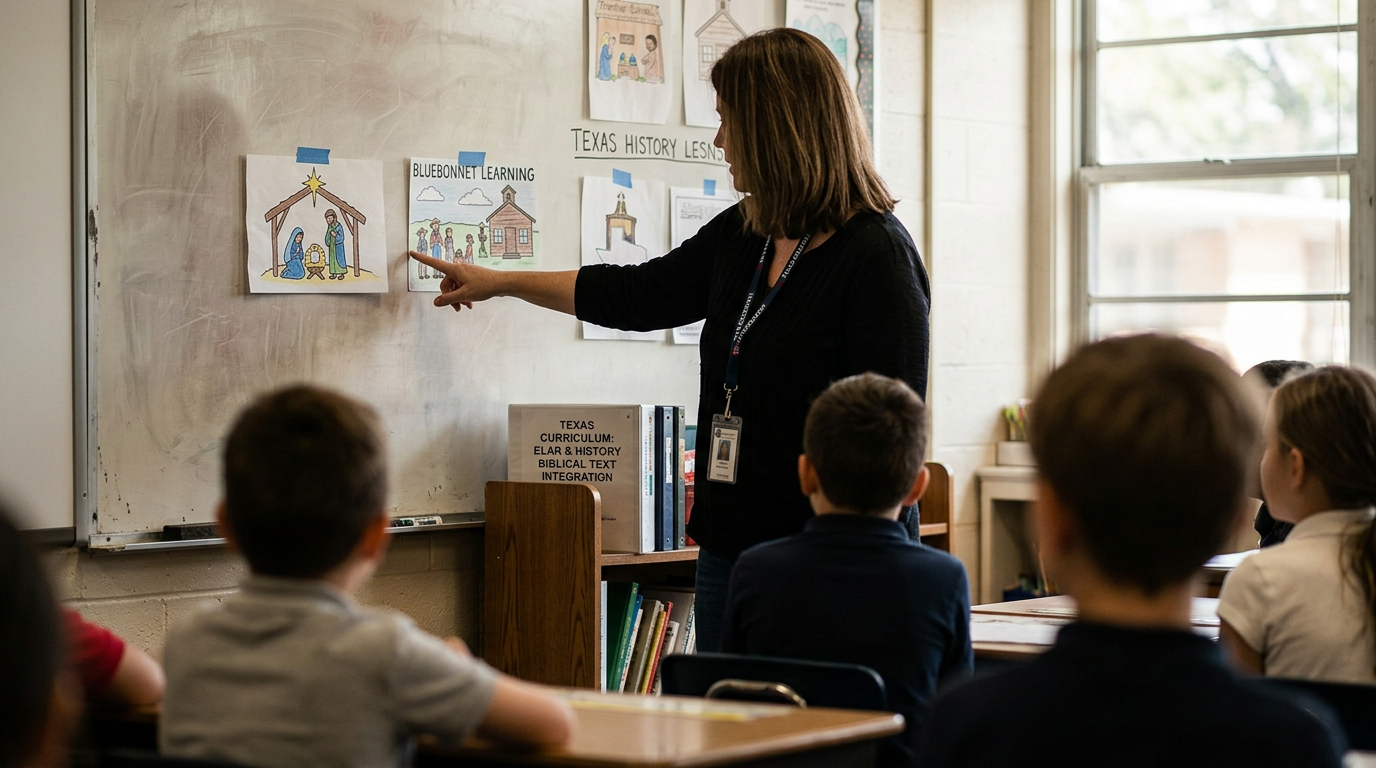
The Texas State Board of Education (SBOE) is currently evaluating a transformative shift in the instructional materials provided to public elementary schools across the state. This new initiative, often referred to as the Bluebonnet Learning Framework, proposes a curriculum that weaves biblical narratives and Christian historical contexts directly into English Language Arts and Reading (ELAR) lessons. Historically, Texas has been at the forefront of the 'textbook wars,' a series of debates spanning decades regarding how much religious influence or secular philosophy should dictate classroom standards. This latest movement follows a legislative directive from the 88th Texas Legislature, which tasked the Texas Education Agency with developing high-quality, state-owned instructional materials to support teachers and improve student literacy rates across various demographics. The proposal has sparked intense interest from parents, educators, and advocacy groups who are navigating the balance between cultural literacy and the traditional separation of religious instruction from public governance. Under the proposed guidelines, students in kindergarten through fifth grade would encounter lessons that include the Story of Esther, the Last Supper, and the Sermon on the Mount as part of their standard reading comprehension and history blocks. Proponents of the change argue that these texts are foundational to understanding Western civilization, literature, and legal systems. They contend that a student cannot fully grasp Shakespeare, the Magna Carta, or the motivations of the American Founding Fathers without a working knowledge of biblical allusions and parables. Conversely, critics express concern that the curriculum might prioritize specific religious viewpoints over a broader, global historical perspective, potentially marginalizing students from non-Christian backgrounds or secular households. The SBOE is expected to hold multiple hearings and public comment periods before a final vote determines if these materials will be incentivized for use in the state's 1,200 school districts.
Texas relevance
As the second-largest school system in the United States, Texas often dictates the national market for educational materials. Decisions made in Austin regarding the inclusion of religious texts impact millions of Texas students and set a precedent for other states considering similar legislative reforms. The debate is particularly relevant to local school boards, who retain the final authority to adopt or reject state-recommended materials. However, a new state law provides a financial incentive—amounting to $40 per student—for districts that choose to utilize these state-approved open-education resources. This fiscal component ensures that the SBOE's decision will have a direct impact on district budgets from El Paso to Beaumont, making the curriculum debate a central issue for Texas taxpayers and local administrators alike.
The Bluebonnet Learning Framework Explained
The Bluebonnet Learning Framework is the result of years of research into how Texas students acquire knowledge. Instead of teaching reading as a standalone skill using disconnected short stories, the framework seeks to build 'background knowledge.' This pedagogical theory suggests that children understand what they read much better if they already have a framework of historical and cultural facts to attach new information to.
By including biblical stories, the Texas Education Agency argues it is providing students with the tools to understand the world around them. For example, a lesson on the Good Samaritan provides a moral and literary framework that appears frequently in Western law and civic volunteerism. The state maintains that these inclusions are not intended to proselytize, but rather to ensure that Texas graduates are culturally literate in a way that aligns with the history of the United States.
State vs. Local Control in the Decision Process
Texas has a long history of valuing local control, and the current curriculum proposal respects that tradition on paper. No school district is legally forced to adopt the Bluebonnet materials. Each of the 1,200 independent school districts (ISDs) in Texas has its own elected board that chooses which textbooks and lesson plans to purchase for their classrooms.
However, the role of the State Board of Education cannot be understated. By placing these materials on the approved list, the state provides a stamp of legitimacy and a significant financial 'carrot.' Districts that are struggling with budget deficits may find the $40-per-student incentive too attractive to pass up, even if there is community pushback. This creates a complex dynamic where local boards must weigh their pedagogical preferences against the financial well-being of their schools.
Comparative History and Global Perspectives
One of the primary critiques of the new curriculum is that it may reduce the amount of time dedicated to non-Western or non-Christian world history. Educational analysts have pointed out that in the grades where biblical stories are being expanded, other global civilization modules have been compressed. This has led to a debate over whether the 'limited hours' in a school day are being used in a way that prepares students for a globalized economy.
Supporters of the change argue that a mastery of one's own cultural heritage must come before an exploration of world history. They suggest that the previous curriculum attempted to cover too many disparate cultures at a surface level, resulting in students who knew very little about anything. The new focus is intended to be 'deep rather than wide,' focusing on the specific pillars—including the Greco-Roman and Judeo-Christian traditions—that built the American Republic.
Legal Challenges and Constitutional Concerns
Organizations like the ACLU and various secular advocacy groups are already signaling potential legal challenges. The central question revolves around the First Amendment's Establishment Clause. While the Supreme Court has ruled that the Bible can be taught for its literary and historical value, the line between academic study and religious endorsement is often thin and subject to judicial interpretation.
Texas Attorney General Ken Paxton has frequently defended the state's right to integrate traditional values into the public sphere. If the SBOE moves forward with the curriculum, Texas could become the center of a landmark federal case that clarifies exactly how religious texts can be used in 21st-century public education. The outcome would have national implications for the growing 'school choice' and 'parental rights' movements.
Feedback from Texas Parents and Teachers
Public testimony during recent SBOE hearings has been split. Many parents have arrived in Austin to express their gratitude, stating that they want their children to share the values and historical knowledge that shaped their own upbringings. They view the curriculum as a way to reinforce the family unit and provide a stable moral foundation in an increasingly chaotic cultural landscape.
Teachers, on the other hand, have voiced concerns regarding the implementation of the materials. Educators in diverse districts like Houston or Dallas wonder how to approach these lessons in classrooms where dozens of different faiths are represented. There is also a practical concern regarding teacher training; many elementary teachers do not feel equipped to navigate the theological nuances that may arise during a discussion of a biblical passage, even in a historical context.
The Role of the Texas Legislature
The push for this curriculum did not emerge in a vacuum; it is the direct result of House Bill 1605, passed during the 88th legislative session. This bill was championed by conservative lawmakers who argued that teachers were being overwhelmed by the need to create their own lesson plans from scratch. By providing state-vetted, high-quality materials, the legislature aimed to reduce teacher burnout and ensure a standard level of rigor across the state.
The political climate in Texas has shifted toward a more explicit defense of traditional Western education. Following the success of HB 1605, several lawmakers have indicated that they intend to continue refining the state’s educational standards to emphasize civic virtue and traditional history. This curriculum represents the first major 'test case' for this new legislative philosophy.
Analysis
OPINION: The move to reintegrate biblical literacy into the classroom is a calculated response to a decade of declining reading scores and a perceived loss of cultural continuity in the public square. By framing the Bible as a literary and historical anchor rather than a purely theological one, the Texas Education Agency is attempting to reclaim a 'classical' approach to education that was once standard in American schooling. While critics view this as a breach of the establishment clause, supporters see it as a necessary correction to an era of educational 'neutrality' that has left many students unable to decipher the most common metaphorical references in historical documents. The real test for this curriculum won't just be the SBOE vote, but whether it actually leads to the promised gains in student comprehension and civic understanding without polarizing the communities it is designed to serve.
Source attribution
This story was reported using a public release from the Texas History Stories (Google News). Keep TX Red rewrote the coverage independently and links to the official statement for verification.
Frequently Asked Questions
- Will my child be forced to study the Bible in a Texas public school?
- Not necessarily. The State Board of Education provides a list of approved curriculum materials, but it is ultimately up to your local school district's board of trustees to decide which books and lessons are used. If your district chooses to adopt the state-owned materials, those lessons will be part of the standard curriculum, though they are presented from a historical and literary perspective rather than as religious instruction.
- Why is the state providing money to districts that use this curriculum?
- Under House Bill 1605, the Texas Legislature created a financial incentive to encourage districts to use 'High-Quality Instructional Materials' (HQIM) developed or approved by the state. The goal is to ensure that all students have access to rigorous, vetted content and to save districts money on purchasing expensive third-party textbooks by providing a state-owned alternative.
- What happens if a parent objects to these lessons?
- Texas law traditionally allows for parental review of all instructional materials. Parents can voice their concerns to their local school board during public meetings. However, since these lessons are integrated into the core English Language Arts and Reading (ELAR) blocks, opting out of specific readings can be complicated depending on district policy. Many districts are awaiting further guidance from the TEA on how to handle specific parental objections.
Official Sources
Take the next step
Browse the Newsroom →Read more about Keep Texas Red → Our full guide to what Keep Texas Red means and why Texans support it.
Get Texas updates delivered weekly.
Independent Texas reporting on politics, policy, and daily life. One email a week. Unsubscribe anytime.
Keep TX Red Newsroom
The Keep Texas Red Editorial Staff produces nonpartisan explainers, policy breakdowns, and educational resources to help Texans understand how their government works. All content is reviewed for accuracy and updated regularly.
About Keep TX Red →