Democratic Shifts in Houston: Sylvester Turner Ousts Longtime Incumbent Al Green in Ninth District Primary
Former Houston Mayor Sylvester Turner unseats nine-term Congressman Al Green in a pivotal Texas Democratic primary runoff for the Ninth District.
Editorial disclaimer: Opinions and analysis on Keep TX Red are editorial content — not statements of fact. See our editorial standards.
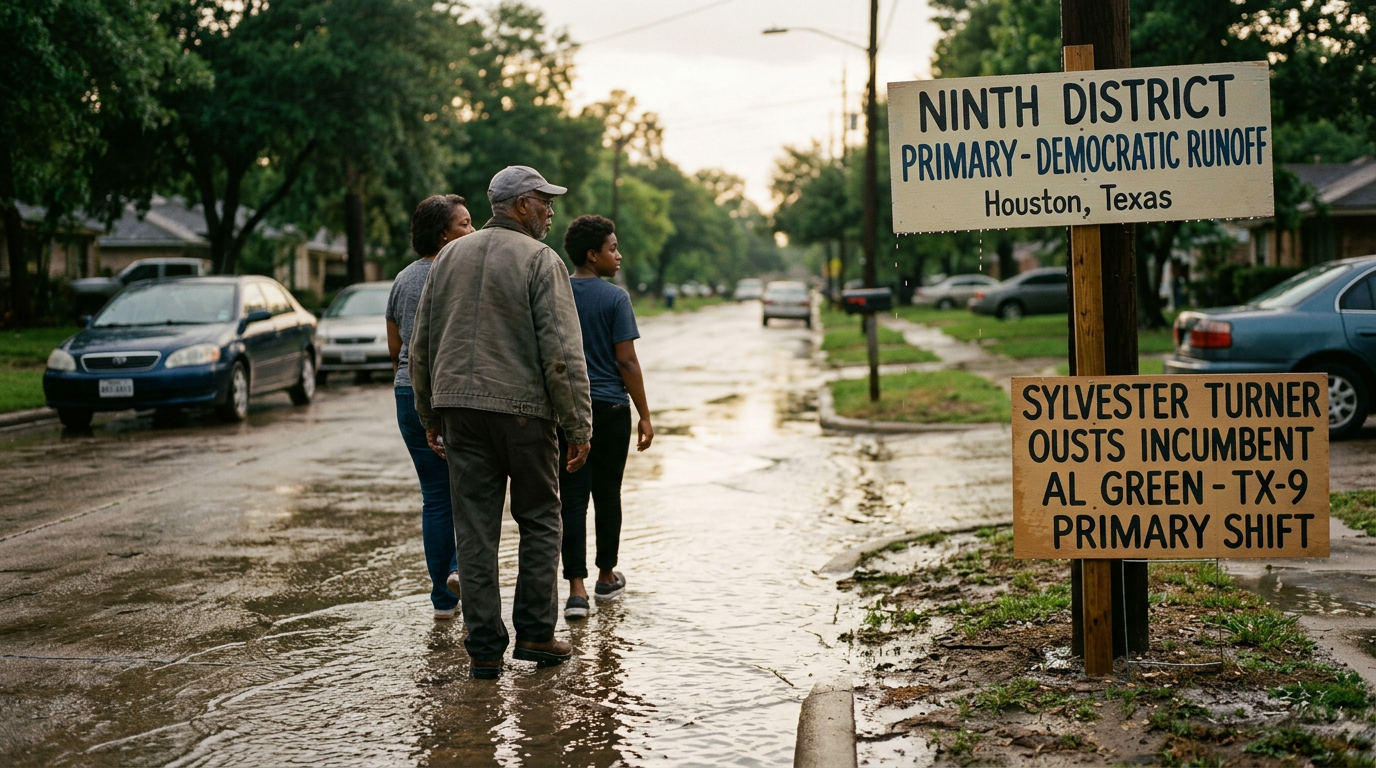
In a significant shift for Houston’s political landscape, former Mayor Sylvester Turner secured a victory over nine-term incumbent Representative Al Green in the Democratic primary runoff for Texas’ Ninth Congressional District. This contest featured two of the most prominent Black leaders in the state of Texas, representing a generational and strategic crossroads for the district. The victory by Turner reflects a potential change in the legislative approach for the deep-blue seat, which spans parts of Harris and Fort Bend counties. Historically, the Ninth District has been a stronghold for the Democratic Party, and the primary winner is widely expected to cruise through the general election in November. The context of this race is rooted in the long-standing influence of both men within the Houston community. Al Green had served in the U.S. House of Representatives since 2005, carving out a niche as a staunch advocate for civil rights and famously becoming one of the first members of Congress to call for federal impeachment proceedings against executive leadership. Conversely, Sylvester Turner recently transitioned out of the Houston Mayor's office, where he tackled significant crises, including Hurricane Harvey recovery and the COVID-19 pandemic. The clash between an established federal lawmaker and a high-profile local administrator created a high-stakes environment where voters were forced to choose between experience in the D.C. capital and executive leadership at home.
Texas relevance
The Ninth Congressional District of Texas is a critical hub for the state’s urban political influence, covering key portions of the Houston metropolitan area in Harris and Fort Bend counties. For decades, this district has been used as a platform for elevating issues of housing equity and civil rights on the national stage. The transition from Green to Turner marks a major change in the Texas delegation to Washington, as Turner brings a different network of alliances formed during his time in the Texas Legislature and as the chief executive of the nation's fourth-largest city. This outcome signals that Houston voters may be seeking a shift toward a more pragmatic, project-focused representation that emphasizes tangible local infrastructure and economic development over symbolic legislative stances.
The Evolution of the Ninth District
Texas’ 9th Congressional District has long been a bastion of Democratic stability in a state that is otherwise dominated by the GOP. Covering southwestern Houston and expanding into Missouri City and parts of Pearland, the district is highly diverse and serves as a cultural and economic anchor for Black and Hispanic communities. Al Green’s tenure in this seat was defined by his work on the Financial Services Committee and his vocal presence on the House floor concerning civil rights and social justice. His departure represents the loss of significant seniority for the Texas Democratic delegation, which relies on long-serving members to navigate the complex committee assignments in Washington.
Sylvester Turner enters this vacuum not as a newcomer, but as a seasoned political veteran who served nearly three decades in the Texas House of Representatives before becoming Mayor of Houston. His understanding of the intersection between state and federal funding is expected to be a centerpiece of his tenure. During the campaign, Turner emphasized his ability to 'get things done,' citing the various redevelopment projects he oversaw in Houston. This rhetoric resonated with voters who felt that while Green was a moral voice in Washington, a more hands-on approach was needed to secure federal resources for the district’s aging infrastructure and burgeoning population.
Runoff Dynamics and Voter Turnout
Primary runoffs in Texas are traditionally low-turnout affairs, often decided by the most engaged segments of the electorate. In this instance, the battle between Green and Turner drew significant attention, turning the runoff into a referendum on the future of Houston’s federal representation. Data from Harris and Fort Bend counties indicated that momentum shifted toward Turner in the final weeks of the campaign, bolstered by a series of endorsements from local council members and community organizers who had previously worked with the Mayor’s office.
Al Green’s campaign leaned heavily on his record of service and his accessibility to his constituents. He often reminded voters of his commitment to underrepresented groups and his willingness to take lonely stands for what he believed was right. However, the 'Turner Machine,' as local pundits often call the former mayor’s political operation, proved too formidable to overcome. The organizational capacity to move voters during a May runoff is a specialized skill in Texas politics, and Turner’s team utilized every tool at their disposal to ensure his base showed up at the polls.
Impact on the Texas Democratic Delegation
The departure of Al Green will lead to a reshuffling of responsibilities among Texas Democrats in the U.S. House. With his exit, the delegation loses a member with deep institutional knowledge regarding the federal banking system and housing policy. Turner will likely seek to fill this gap by leveraging his experience in state-level appropriations and his tenure as a chief executive. The Texas delegation is currently in a state of flux as older members retire or face tough primary challenges, making Turner’s entry a stabilizing force for those looking for experienced leadership.
One of the primary concerns for Texas as a whole is how this change affects the state’s ability to secure federal grants for transportation and flood mitigation. Historically, the Houston area has required significant federal intervention to combat the effects of climate-driven disasters. Turner’s experience in navigating the bureaucracy of FEMA and the Department of Housing and Urban Development during his time as Mayor could provide a more streamlined pathway for federal assistance to reach his home district, potentially benefiting the wider Southeast Texas region.
A History of Houston Powerhouses
The Houston area has a storied history of producing influential political figures who command national attention. From Barbara Jordan to Mickey Leland, the Ninth District and its predecessors have been the launching pad for leaders who shaped the nation’s conscience. Al Green was seen as a successor to this tradition, often using his floor time to speak on issues that transcended the borders of his district. His loss marks a rare instance where a sitting incumbent of such high stature is unseated by a peer from within his own party.
Sylvester Turner’s move to Congress is seen by many as a continuation of his own storied career. Having been raised in the Acres Homes community of Houston, Turner has often spoken about the 'lived experience' of his constituents. His transition from the state house to the mayor’s office and now to the federal level is a trajectory few in Texas politics have successfully navigated. As he prepares to represent the Ninth District, the eyes of the state will be on him to see if he can translate his local executive success into federal legislative gains.
What the Future Holds for Al Green
While Al Green may have lost his seat in Congress, his legacy in Houston remains significant. His twenty years of service have left an indelible mark on the district, particularly in the realms of judicial reform and economic justice. Many observers believe that Green will remain an active voice in the community, potentially serving as an advisor or taking on a role within one of the many civil rights organizations he has supported throughout his career. His graceful exit will be essential for party unity as the general election approaches.
The political landscape in Texas continues to evolve, and the 2026 primary cycle has proven that no seat is entirely safe from a challenger with high name recognition and a strong local track record. As Turner prepares for the general election, he will need to bridge the gap with Green’s most loyal supporters to ensure the district remains a unified Democratic stronghold. The primary may be over, but the work of reconciling two different visions for Houston’s future is only just beginning.
Analysis
The unseating of Al Green by Sylvester Turner is not merely a personnel change; it is an ideological recalibration within the Texas Democratic caucus. While both candidates share similar policy platforms, Turner’s victory highlights the power of mayoral name recognition and the desire for 'results-oriented' politics. During his time as Mayor, Turner cultivated deep ties with the business community and labor unions, which likely provided the financial and organizational muscle needed to overcome a tenured incumbent. Green’s defeat may also serve as a warning to other long-term incumbents that tenure alone is no longer a shield against localized executive leadership. For the Republican Party in Texas, this shift provides a new dynamic to analyze as they prepare for constitutional challenges and policy debates involving one of the state’s most diverse and economically significant districts.
Source attribution
This story was reported using a public release from the Texas Congressional Delegation (Google News). Keep TX Red rewrote the coverage independently and links to the official statement for verification.
Frequently Asked Questions
- Why was there a runoff for the 9th District seat?
- In Texas, if no candidate receives more than 50% of the vote in the initial primary, the top two candidates must face each other in a runoff. Because the 9th District is heavily Democratic, the winner of this primary runoff is the presumptive favorite for the general election.
- What counties are included in Texas's 9th Congressional District?
- The district primarily covers portions of southwestern Houston in Harris County and extends into the suburban areas of Fort Bend County, including Missouri City and parts of Stafford.
- What was Sylvester Turner's prior role before running for Congress?
- Sylvester Turner served as the Mayor of Houston from 2016 to 2024. Prior to that, he served for 26 years in the Texas House of Representatives.
- How long had Al Green served in Congress?
- Representative Al Green was first elected to the U.S. House of Representatives in 2004 and began his first term in January 2005. He served nine full terms before this primary challenge.
Official Sources
Take the next step
Browse the Newsroom →Read more about Keep Texas Red → Our full guide to what Keep Texas Red means and why Texans support it.
Get Texas updates delivered weekly.
Independent Texas reporting on politics, policy, and daily life. One email a week. Unsubscribe anytime.
Keep TX Red Newsroom
The Keep Texas Red Editorial Staff produces nonpartisan explainers, policy breakdowns, and educational resources to help Texans understand how their government works. All content is reviewed for accuracy and updated regularly.
About Keep TX Red →