Harris County Election Procedures Under Fire After Texas Secretary of State Receives Voter Registration Complaint
Texas SOS Jane Nelson alerts Harris County of a voter registration complaint that could lead to state oversight and mandatory audits.
Editorial disclaimer: Opinions and analysis on Keep TX Red are editorial content — not statements of fact. See our editorial standards.
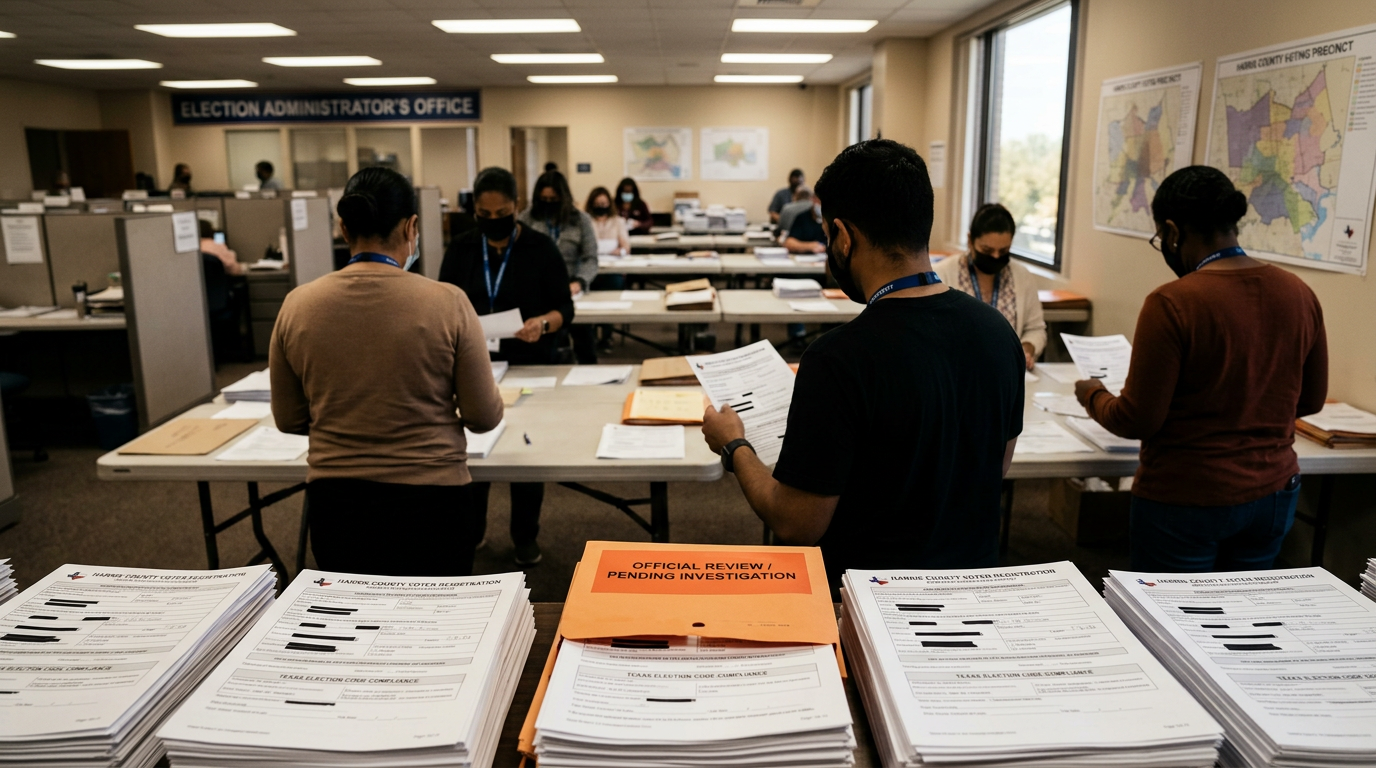
The Office of the Texas Secretary of State has officially notified Harris County officials regarding a formal complaint concerning potential irregularities in the county’s voter registration processes. Secretary Jane Nelson issued the notice on November 25, indicating that the state is initiating a preliminary investigation based on allegations of non-compliance with the Texas Election Code. This move follows a series of legislative reforms passed by the Texas Legislature over the last few years designed to strengthen the oversight of local election administrators. If the investigation confirms the validity of the complaint, Harris County could face a range of administrative responses, including the potential for state-mandated conservatorship or specific oversight protocols. Historically, Harris County has faced significant scrutiny from state leadership due to technical failures during the 2022 midterm elections, which resulted in a shortage of ballot paper at dozens of polling locations. These past incidents served as a catalyst for new laws that allow the Secretary of State to intervene directly in county election management if specific performance thresholds are not met or if repeated complaints of irregularities surface. The current complaint focuses specifically on how the county processes new registrations and maintains the accuracy of the voter rolls, a critical component of ensuring that only eligible citizens participate in the democratic process. Secretary Nelson’s office has emphasized that the goal of this inquiry is to ensure that all local entities are operating under the uniform standards required by state law. The notification creates a formal timeline for the county to respond and for the state to determine whether a full-scale audit or more intensive monitoring is required under the current legal framework.
Texas relevance
As the largest county in Texas and the third-largest in the United States, Harris County is the primary battleground for election policy disputes in the Lone Star State. The stability and accuracy of its voter rolls affect millions of Texas citizens and have a significant impact on statewide election results. Following the passage of Senate Bill 1933 by the 88th Texas Legislature, the state gained new powers to intervene in the election offices of counties with populations exceeding 4 million—a threshold that currently applies specifically to Harris County. This investigation is a test of those administrative powers and could set a long-term precedent for how Houston-area elections are conducted and supervised by state-level officials in Austin.
The Legal Basis for State Intervention
The current investigation is rooted in the statutory authority granted to the Secretary of State under several key provisions of the Texas Election Code. Specifically, recent amendments have clarified the steps the Secretary of State must take when a complaint is received that alleges a recurring problem with registration or voting procedures. The formal notification serves as the official 'trigger' for a process that moves from information gathering to potential remediation.
Under these rules, the Secretary of State has the power to appoint a team of monitors or a conservator to oversee the functions of the county's election office. This is not a step taken lightly, as it represents a significant shift in the balance of power between local county governments and the state executive branch. However, the law was specifically designed to address systemic issues in large urban centers where administrative failures can have outsized impacts on the integrity of the total vote count.
Historical Context of Harris County Election Issues
The relationship between Harris County and the Texas Secretary of State has been strained for several years. The 2022 General Election was a turning point, as numerous polling locations reported running out of paper, leading to long delays and some voters allegedly leaving without casting a ballot. This sparked a series of lawsuits and a state-ordered audit that highlighted gaps in the county's logistical planning and staff training.
In response to these failures, the Texas Legislature passed laws to dissolve the independent Election Administrator's office in Harris County, returning those duties to the County Clerk and the Tax Assessor-Collector. This latest complaint regarding voter registration falls under the purview of these revamped offices, testing their ability to handle the heavy administrative load required for a county with over 2.5 million registered voters.
The Scope of the Current Investigation
While the specific details of the complaint have not been made public to protect the integrity of the ongoing inquiry, it is known to involve the handling of voter registration applications. In Texas, the process of registering a voter involves verifying eligibility, ensuring the data is correctly entered into the statewide 'TEAM' system, and mailing out registration cards in a timely manner. Any delay or error in this chain can result in a citizen being unable to vote on election day.
The investigation will likely look at whether the county is following the required timeline for processing applications and whether it is properly utilizing the United States Postal Service's change-of-address data to keep its lists current. Maintaining clean voter rolls is a mandatory requirement under both state and federal law, intended to prevent double-voting and the inclusion of non-citizens or deceased individuals on the rolls.
Potential Outcomes and State Oversight
If Secretary Nelson's office determines that a violation of the Election Code occurred, the state can issue a corrective action plan. This plan serves as a roadmap that the county must follow to avoid further penalties. Failure to adhere to the corrective action plan can lead to the more severe step of 'administrative oversight,' where state officials are stationed within the county office to approve every major decision.
Alternatively, if the complaint is found to be baseless or corrected through minor adjustments, it may be resolved without further escalation. However, given the high-profile nature of Harris County's recent election history, the state is expected to conduct a thorough and transparent review to satisfy the concerns of the complainants and the general public.
Implications for Future Texas Elections
This case is being watched closely by election officials across the other 253 Texas counties. It represents the first major application of the investigative powers expanded in the 2023 legislative session. The outcome will likely define the boundaries of how much autonomy large counties maintain in the face of state-level concerns over election administration.
For voters in Harris County, the investigation offers a potential path toward more reliable services. Regardless of the political leanings of the administration in power, the fundamental expectation of the electorate is that their registration will be handled accurately and their ballots will be counted securely. The Secretary of State's intervention is fundamentally about meeting that basic service standard.
Analysis
Opinion: The swift action by Secretary Jane Nelson signals that the State of Texas is no longer willing to tolerate the administrative friction that has plagued Harris County’s elections department since the abolition of the non-partisan Election Administrator position. For years, critics have argued that Harris County has been slow to purge ineligible voters and disorganized in handling new registrations, leading to a loss of public trust. This complaint-driven investigation is effectively the state using its newly sharpened 'veto' power to ensure that the largest voting bloc in Texas remains secure. While local officials may frame this as political overreach, the reality is that uniform application of the law is necessary for disenfranchised voters to have confidence in the system. If Harris County is found to be in violation, the ensuing state oversight will likely be seen as a victory for those who have spent the last three legislative sessions advocating for tighter controls on local election officials.
Source attribution
This story was reported using a public release from the Texas Secretary of State. Keep TX Red rewrote the coverage independently and links to the official statement for verification.
Frequently Asked Questions
- What prompted the Secretary of State to investigate Harris County?
- A formal complaint was filed with the Secretary of State’s office alleging specific failures or irregularities in the voter registration process. Under the Texas Election Code, such complaints must be investigated to ensure compliance with state law.
- Can the state take over Harris County elections?
- Under current Texas law, particularly SB 1933, the Secretary of State has the authority to implement administrative oversight or a conservatorship in counties with populations over 4 million if they fail to follow proper election procedures.
- Who is currently responsible for voter registration in Harris County?
- Following the dissolution of the Election Administrator's office, voter registration duties were returned to the Harris County Tax Assessor-Collector, while election management is handled by the County Clerk.
- What happens if the investigation finds the complaint is valid?
- The county will likely be issued a corrective action plan highlighting what must be changed. Failure to comply with this plan can result in the state placing the county's election functions under direct state monitoring.
Official Sources
Take the next step
Browse the Newsroom →Read more about Keep Texas Red → Our full guide to what Keep Texas Red means and why Texans support it.
Get Texas updates delivered weekly.
Independent Texas reporting on politics, policy, and daily life. One email a week. Unsubscribe anytime.
Keep TX Red Newsroom
The Keep Texas Red Editorial Staff produces nonpartisan explainers, policy breakdowns, and educational resources to help Texans understand how their government works. All content is reviewed for accuracy and updated regularly.
About Keep TX Red →