Texas Breaks All-Time Record with 3 Million Active Business Entities as Economic Growth Accelerates
Governor Greg Abbott and Secretary Nelson announce a historic milestone for the Texas economy with over 3 million active registered businesses.
Editorial disclaimer: Opinions and analysis on Keep TX Red are editorial content — not statements of fact. See our editorial standards.
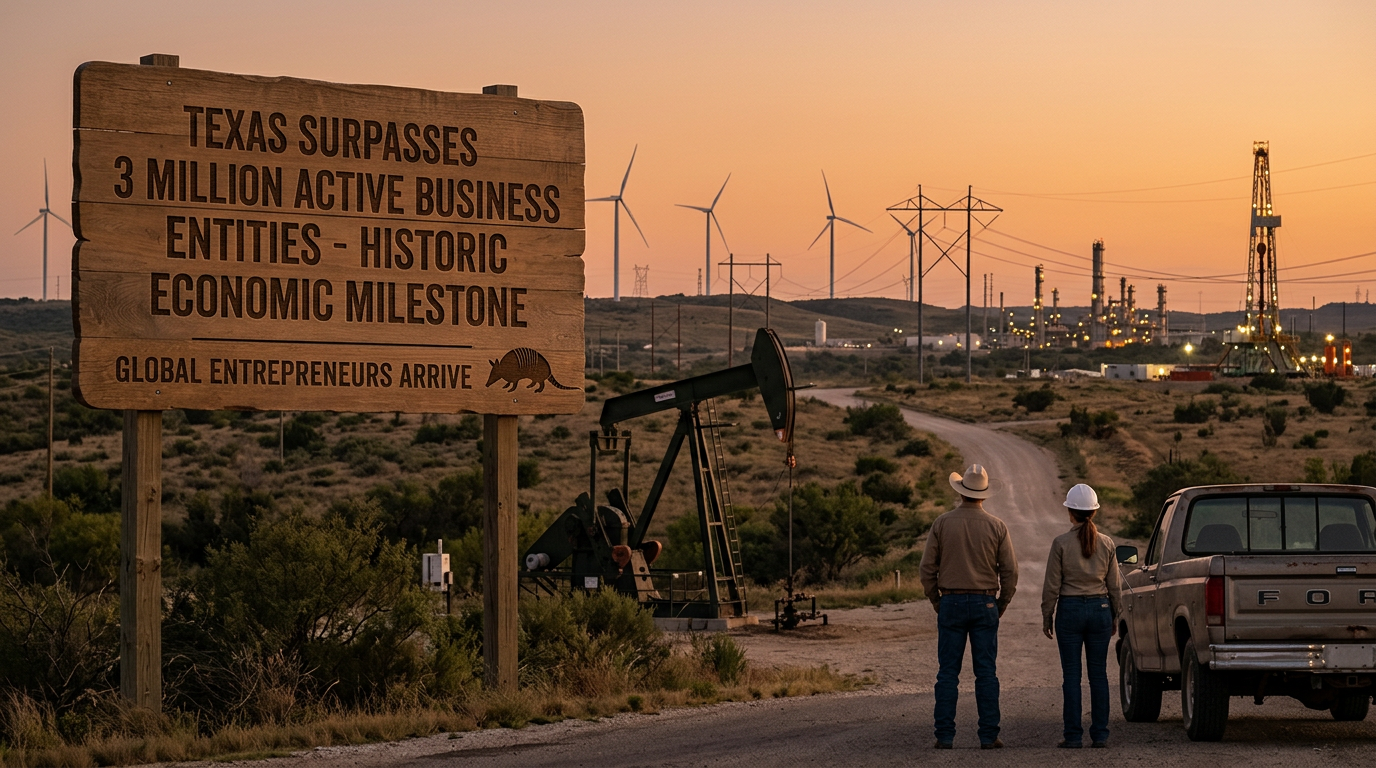
Texas officials have officially confirmed that the state has surpassed 3 million active business registrations, marking a total that has never been reached in the history of the Lone Star State. Governor Greg Abbott and Secretary of State Jane Nelson highlighted this achievement as a testament to the robust regulatory environment and the influx of entrepreneurs migrating to Texas from across the globe. This milestone reflects the total number of corporations, limited liability companies, and other legal entities currently in good standing with the state’s filing office. The announcement serves as a quantitative measure of the massive scaling the state’s private sector has undergone over the last decade, transitioning from a regional powerhouse to a primary hub for international commerce. Historically, Texas has relied on its low tax burden and predictable legal climate to attract investment, and this latest figure suggests those long-standing policies continue to yield significant results in the post-pandemic era.
Texas relevance
This development is directly relevant to every resident of Texas, as the expansion of business entities correlates with job creation, increased property tax revenue, and a diversified state budget. Specifically, the growth is not limited to metropolitan hubs like Austin or Houston; the Secretary of State’s records show filing activity across all 254 counties, indicating that rural and suburban Texas are sharing in this prosperity. For Texans, a high volume of active businesses means more competition for labor, which can drive up wages, and more local options for services and goods. Given that Texas frequently outpaces the national average for GDP growth, the 3 million mark solidifies the state's position as the economic engine of the United States. This growth also puts pressure on state infrastructure, requiring the legislature to consider how business density affects transportation, energy grids, and water resources in the coming years.
Historical Context of the Texas Business Boom
The journey to 3 million active entities did not happen overnight but is the result of decades of intentional policy choices. Following the oil busts of the 1980s, Texas leaders recognized the need to diversify the economy away from a singular reliance on petroleum. This led to the creation of various incentive programs and a concerted effort to market the state as a secondary home for tech and manufacturing firms fleeing high-cost coastal states.
In the early 2000s, the state saw a steady but modest climb in business registrations. However, the last five years have seen an unprecedented acceleration. Factors such as the shift toward remote work and the relocation of major corporate headquarters like Tesla and Hewlett Packard Enterprise have created a 'cluster effect.' When large corporations move, they bring a tail of smaller vendors, law firms, and service providers, all of whom contribute to the active registration count provided by the Secretary of State.
Comparing Texas to other large states reveals a stark contrast. While some jurisdictions have seen stagnant or even declining business counts due to rising overhead and regulatory complexity, Texas has streamlined the filing process through the Secretary of State’s SOSDirect portal. This digital transformation has made it easier for small business owners to maintain their standing, contributing to the high number of 'active' rather than 'lapsed' entities.
The Role of the Secretary of State in Economic Tracking
Secretary of State Jane Nelson oversees the Business and Public Filings Division, which serves as the central hub for all legal business documentation in Texas. This office is responsible for more than just rubber-stamping applications; it ensures that the 3 million entities listed are complying with state transparency laws and filing their biennial reports. This data provides a real-time pulse of the state’s economic health that is often more current than federal labor statistics.
Maintaining a registry of this size requires significant technological infrastructure. The Secretary’s office has focused on reducing the 'friction of doing business' by ensuring that entrepreneurs can register or renew their entities within minutes. This ease of entry is a hidden competitive advantage for Texas, as it allows capital to be deployed quickly without being caught in bureaucratic red tape. The 3 million mark represents a triumph of administrative efficiency as much as economic demand.
The Secretary's office also monitors the diversity of these organizations. Of the 3 million entities, the vast majority are small businesses and LLCs. This indicates that while the Fortune 500 relocations get the most media attention, the backbone of the Texas economy remains the independent entrepreneur. The Secretary of State’s data suggests that the 'Texas Dream' remains accessible to individuals looking to start small and scale within the state’s borders.
Impact on Local Municipalities and Infrastructure
The surge to 3 million businesses has profound implications for local Texas governments. Each new entity registered often requires physical space, whether it be a home office, a retail storefront, or a sprawling warehouse. This demand has kept commercial real estate markets in North Texas and the Greater Houston area resilient, even during periods of national uncertainty. For local school districts and counties, this translates into a stable and growing tax base to fund essential services.
However, this volume of activity also presents challenges. More businesses mean more vehicles on the road and higher demand for electricity. The Texas Department of Transportation (TxDOT) and the Electric Reliability Council of Texas (ERCOT) must use these business growth figures to forecast future load requirements. If the state continues to add businesses at this record pace, the demand for 24/7 reliable power will only intensify, necessitating a continued focus on expanding the state’s energy generation portfolio.
Local chambers of commerce across the state are also seeing the effects of this milestone. Small towns that once saw their populations decline are now seeing a revival as 'boutique' businesses and tech consultants register their entities in lower-cost rural areas. This decentralization of the 3 million businesses ensures that the economic benefits are not locked within the borders of Austin or Dallas, but are instead flowing into the Texas Heartland.
The Competitive Edge Over Other States
Governor Abbott’s celebration of this milestone is a clear signal to other states that Texas intends to remain the top destination for capital investment. By reaching 3 million active entities, Texas has outpaced many of its traditional rivals in business formation. This lead is maintained through a 'business-first' legislative philosophy that discourages the filing of frivolous lawsuits and keeps workers' compensation costs manageable for employers.
The milestone also acts as a powerful recruiting tool. When site selectors and CEOs look at where to expand, they look for 'momentum.' A state that is consistently breaking records for active businesses is seen as a safe bet for long-term investment. This 'success breeds success' cycle is what has allowed Texas to lead the nation in exports for over two decades. The 3 million mark is a psychological threshold that confirms Texas's dominance on the national stage.
Furthermore, the diversity of the 3 million businesses—spanning sectors from aerospace and biotechnology to traditional energy and agriculture—provides a buffer. Unlike states that are overly dependent on a single industry like tourism or finance, Texas has a fragmented and robust business ecosystem. This means that if one sector faces a downturn, the other 2.9 million plus entities continue to provide a foundation for the state's budget and employment levels.
Looking Forward: The Path to 4 Million
The state’s leadership is already looking past this record toward the next million registrations. To maintain this trajectory, Texas will need to continue investing in higher education and vocational training to ensure there is a skilled workforce ready to staff these new businesses. The Governor has emphasized that a business registration is only as good as the employees who make the company run, making workforce development a top priority for upcoming legislative sessions.
Future growth is also expected to be driven by the legal services and technology sectors. As Texas becomes a more prominent legal and financial hub, the number of professional service entities is expected to rise. Additionally, the move toward digital assets and blockchain technology in Texas may lead to a new wave of 'tech-native' entities filing with the Secretary of State, further expanding the registry's scope.
The state also remains focused on international trade. With one of the longest international borders in the country and multiple deep-water ports, Texas is uniquely positioned to be the primary registration hub for companies engaged in cross-border trade. As global supply chains continue to realign, the Texas Secretary of State’s office expects to see even more international players establishing a legal presence in the state to take advantage of its strategic location.
Analysis
While the 3 million figure is a raw metric of registration, its true value lies in what it says about the 'Texas Model' of governance. Critics often argue that rapid growth creates strain, but the sheer volume of new filings suggests that the benefits of a pro-business climate—namely lack of state income tax and streamlined permitting—outweigh the logistical hurdles of expansion. This milestone is likely to be a cornerstone of future policy discussions, as the Governor uses these numbers to justify further deregulation and investment in workforce development. Furthermore, by maintaining a record-breaking number of active entities, Texas creates a 'moat' against national economic downturns; a diversified ecosystem of three million players is far more resilient than one dominated by a few legacy industries like oil and gas.
Source attribution
This story was reported using a public release from the Texas Secretary of State. Keep TX Red rewrote the coverage independently and links to the official statement for verification.
Frequently Asked Questions
- What constitutes an 'active business entity' in Texas?
- An active business entity is a corporation, limited liability company (LLC), partnership, or other legal structure that is registered with the Texas Secretary of State and is currently in good standing. This means the entity has filed all required reports and is authorized to conduct business within the state.
- How does the Secretary of State track these numbers?
- The Secretary of State's Business and Public Filings Division maintains a comprehensive database. When a business is formed, it must file 'Certificates of Formation.' To remain active, businesses must comply with state laws regarding transparency and reporting, allowing the state to provide precise counts of current, operational entities.
- Why is this milestone significant for the average Texan?
- More businesses lead to higher demand for workers, which generally results in more job opportunities and better pay. Additionally, businesses contribute significantly to the tax base, which funds public schools, roads, and emergency services without the need for a state income tax on individuals.
- Has the growth been concentrated in just a few cities?
- No. While major hubs like Dallas and Austin see high volume, the Governor and Secretary of State noted that business formation is happening statewide. The trend indicates that entrepreneurs are finding opportunities in smaller towns and suburban areas, helping to decentralize the state's economic power.
Official Sources
Take the next step
Browse the Newsroom →Read more about Keep Texas Red → Our full guide to what Keep Texas Red means and why Texans support it.
Get Texas updates delivered weekly.
Independent Texas reporting on politics, policy, and daily life. One email a week. Unsubscribe anytime.
Keep TX Red Newsroom
The Keep Texas Red Editorial Staff produces nonpartisan explainers, policy breakdowns, and educational resources to help Texans understand how their government works. All content is reviewed for accuracy and updated regularly.
About Keep TX Red →