Texas apostille services: Secretary of State launches appointment system
Starting August 5, the Texas Secretary of State will offer scheduled appointments for apostille and document authentication services in Austin.
Editorial disclaimer: Opinions and analysis on Keep TX Red are editorial content — not statements of fact. See our editorial standards.
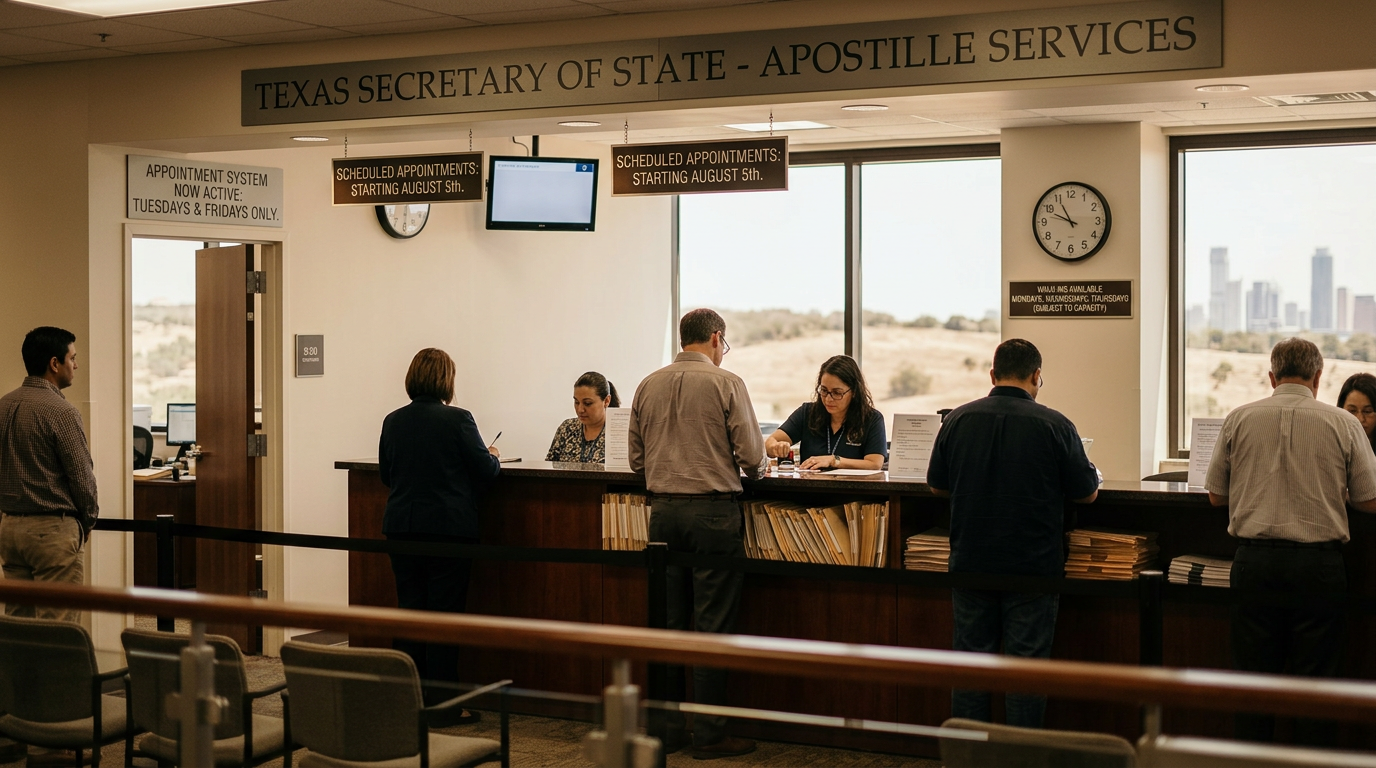
The Texas Secretary of State is modernizing its approach to document authentication by introducing a new appointment system for residents and businesses needing apostille services. Starting August 5, individuals can schedule specific times on Tuesdays and Fridays to have their documents verified at the Secretary of State's office in Austin. This move represents a shift in how the state handles high-priority requests for legal certifications intended for international use. Historically, Texas document verification has been a process that relied heavily on mail-in requests or walk-in traffic, which could result in unpredictable wait times during periods of high demand. By formalizing an appointment structure, the office aims to provide a reliable window for those who have urgent travel, business transactions, or legal requirements abroad. These authentication services are essential for a wide variety of paperwork, ranging from commercial contracts to individual adoption papers and educational transcripts. Jane Nelson, the current Secretary of State, emphasized that this update is part of a broader commitment to making state government more accessible and responsive to the needs of the Texas public.
Texas relevance
As the eighth-largest economy in the world, Texas maintains deep international ties that require constant movement of legal documentation across borders. For residents in cities from Houston to El Paso, having an efficient central hub in Austin for apostilles means faster turnaround times for exporting goods, validating educational credentials for overseas jobs, or finalizing international legal matters. The state previously navigated the challenges of the COVID-19 pandemic by adjusting public access, and this new appointment-style service reflects a permanent evolution toward more organized, tech-forward government interaction. This change specifically impacts Texas citizens who are working in global industries or moving abroad, ensuring that the state's administrative backbone keeps pace with its economic growth.
The Evolution of Texas Document Authentication
Texas has long served as a gateway for international trade, necessitating a robust system for document authentication. An apostille is a specialized certificate issued by the Secretary of State that verifies the authenticity of a signature on a document for use in another country. This process is governed by the Hague Convention of 1961, which simplified the legality of documents between participating nations. Without this verification, a Texas-issued birth certificate or business deed might not be recognized as valid by foreign authorities.
In the past, the volume of these requests has scaled alongside Texas's population growth. The Secretary of State's office handles thousands of certifications annually, ranging from multinational corporate filings to personal documents for military families stationed overseas. The transition to a scheduled appointment system represents a proactive response to the increasing complexity and volume of these submissions. It ensures that the staff can allocate dedicated time to complex files that require immediate verification for international travel or sensitive legal deadlines.
Specific Eligibility and Scheduling Details
Public access to the new appointment system will be available twice a week, specifically on Tuesdays and Fridays. This focused schedule allows the Secretary of State’s staff to balance in-person service with the massive volume of mail-in requests that arrive daily from across the state's 254 counties. Users will be expected to use the official online portal to secure their time slots, ensuring that no one makes the trip to the James Earl Rudder Office Building in Austin without a confirmed window.
The types of documents eligible for these services include notarized documents, certificates issued by state agencies, and educational records from public or private institutions in Texas. It is important to note that the Secretary of State only authenticates documents from Texas; documents from other states or the federal government must be handled by their respective jurisdictions. This new system expects to handle up to a certain number of documents per appointment, preventing single users from monopolizing the allotted time blocks and ensuring equitable access for all citizens.
Economic Impact on Texas Business Operations
For the Texas business community, time is often the most valuable currency. Companies involved in international construction, oil and gas exports, or cross-border tech services frequently require authenticated corporate bylaws or certificates of good standing. Delays in receiving an apostille can pause multimillion-dollar contracts or stall the opening of a foreign branch office. By providing a predictable, scheduled service, the Secretary of State is directly supporting the ease of doing business in Texas.
This improvement in administrative throughput reinforces the state's reputation as a business-friendly environment. When corporate legal teams can guarantee a Tuesday or Friday turnaround for vital paperwork, they can plan their international expansions with higher precision. It also reduces the necessity for expensive third-party expediting services, as business owners can now manage these filings directly with a higher degree of certainty regarding the timeline.
Practical Benefits for Individual Texans
Beyond the corporate world, individual Texans often find themselves in need of an apostille for life-changing events. International adoptions, marriage ceremonies held abroad, and the pursuit of dual citizenship frequently require the authentication of vital records. These processes are inherently stressful and bound by strict deadlines. The ability to book an appointment provides peace of mind to families who might otherwise be waiting weeks for a mail-in response during peak seasons.
Students and researchers are another demographic that stands to benefit. As Texas universities attract international talent and send local students to global programs, the demand for authenticated transcripts and diplomas has surged. Providing a clear path for in-person service helps graduating students meet visa deadlines and secure employment abroad. The Secretary of State’s move acknowledges these human elements of state administration, offering a face-to-face option for those navigating complex international bureaucracies.
Security and Verification Standards
Security remains a top priority during the authentication process. The Secretary of State’s office must meticulously verify that the notary public or state official who signed the document is in good standing and that the signature matches the records on file. This layer of security protects the integrity of Texas documents on the world stage, preventing fraud and ensuring that Texas-issued paperwork is beyond reproach in foreign courts and government offices.
The appointment system may actually enhance security by allowing for more controlled interactions between staff and the public. By managing the flow of visitors, the office can maintain a secure environment while still providing high-quality service. Staff members are trained to recognize the specific requirements of various international treaties, ensuring that the certificate attached to the document—be it a standard apostille or a general authentication for non-Hague nations—meets the exacting standards of the destination country.
The Future of Texas Secretary of State Services
The rollout of appointment-based apostille services may serve as a pilot for other departments within the Secretary of State’s office. As Jane Nelson continues her tenure, the focus on digital integration and customer-centric scheduling is expected to expand. This mirrors broader efforts across the Texas state government to move away from legacy 'take-a-number' systems toward data-driven queuing and online document management.
Future enhancements could include expanded hours or more specialized service tracks if the August 5 launch proves successful in reducing backlogs. For now, the focus remains on a smooth transition to the Tuesday and Friday schedule. The office has signaled that they will closely monitor user feedback and processing times to determine if adjustments are needed to meet the evolving demands of the Texas public and the global entities they interact with daily.
Analysis
This procedural update reflects a growing trend in Texas government to adopt private-sector scheduling standards. By moving toward an appointment model for in-person services, Secretary Jane Nelson is effectively reducing the 'time tax' on Texas business owners and legal professionals who previously risked long lines or mail delays. While mail-in services will likely remain the primary volume driver, the Tuesday and Friday appointment windows serve as an essential relief valve for time-sensitive cases. This strategy aligns with a conservative governance approach that prioritizes efficiency and predictable agency performance, reducing the friction points between the state government and the people it serves.
Source attribution
This story was reported using a public release from the Texas Secretary of State. Keep TX Red rewrote the coverage independently and links to the official statement for verification.
Frequently Asked Questions
- What is an apostille and why would a Texan need one?
- An apostille is a form of authentication issued to documents for use in countries that participate in the Hague Convention. Texans typically need one for international business contracts, foreign adoption paperwork, or when using a Texas diploma or birth certificate in another country.
- How do I schedule an appointment for these services?
- Appointments must be scheduled through the official Texas Secretary of State website. The service is available specifically on Tuesdays and Fridays starting August 5, 2025. It is recommended to check the site early as slots are expected to fill quickly.
- Can I still mail in my documents for authentication?
- Yes, the traditional mail-in service remains available for those who cannot travel to Austin. The new appointment system is an additional option for those seeking a more predictable in-person service window.
- What documents are eligible for authentication in Austin?
- The office authenticates documents signed by Texas officials, such as notarized papers, state agency records, and transcripts from Texas schools. They cannot authenticate federal documents or records from other U.S. states.
Official Sources
Take the next step
Browse the Newsroom →Read more about Keep Texas Red → Our full guide to what Keep Texas Red means and why Texans support it.
Get Texas updates delivered weekly.
Independent Texas reporting on politics, policy, and daily life. One email a week. Unsubscribe anytime.
Keep TX Red Newsroom
The Keep Texas Red Editorial Staff produces nonpartisan explainers, policy breakdowns, and educational resources to help Texans understand how their government works. All content is reviewed for accuracy and updated regularly.
About Keep TX Red →