Texas Secretary of State Finalizes Ballot Order for Upcoming Constitutional Amendment Election
Texas prepares for the November election as the Secretary of State conducts the official drawing for upcoming state constitutional amendments.
Editorial disclaimer: Opinions and analysis on Keep TX Red are editorial content — not statements of fact. See our editorial standards.
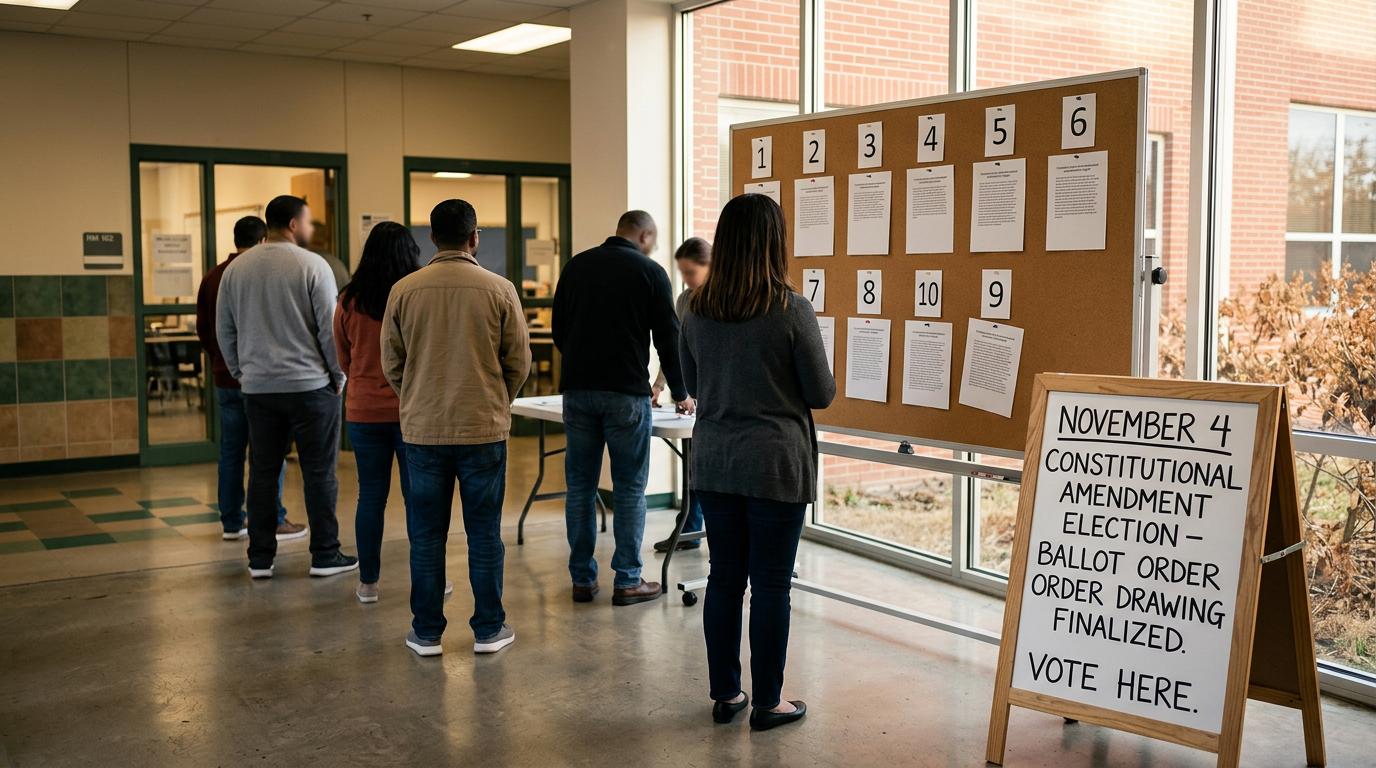
The Texas Secretary of State’s office has officially scheduled a public drawing to determine the numerical sequence of proposed constitutional amendments that will appear on the November 4 ballot. This administrative procedure is a critical step in the state’s democratic process, ensuring that the presentation of legislative changes to voters is handled with transparency and impartiality. Historically, the Texas Constitution, which was adopted in 1876, has been amended more than 500 times, as the document requires voter approval for many structural changes that other states might handle through simple legislation. This upcoming drawing follows the conclusion of the most recent legislative session, during which lawmakers approved several specific joint resolutions that now require a final mandate from the Texas electorate. The process of drawing for ballot order is dictated by the Texas Election Code to prevent any perceived bias that might arise from alphabetical or chronological sorting. By utilizing a randomized drawing system, state officials provide a neutral playing field for the various propositions, which can range from property tax relief and infrastructure funding to changes in judicial eligibility. Once the numbers are assigned, the Secretary of State will coordinate with county election officials across the state’s 254 counties to ensure that ballots are printed and programmed correctly ahead of the early voting period and Election Day. This procedural consistency is vital for maintaining public trust in the integrity of the Texas electoral system.
Texas relevance
The outcome of this drawing directly impacts every registered voter across the state of Texas, from the Panhandle to the Rio Grande Valley. In Texas, the state constitution is notoriously detailed, meaning that significant policy shifts—such as those involving the Texas Water Development Fund, the Permanent School Fund, or state-wide tax exemptions—cannot be enacted without the direct consent of the voters. This specific drawing sets the stage for the educational campaigns that will take place in cities like Austin, Houston, Dallas, and San Antonio, as advocacy groups and local governments begin to refer to the propositions by their officially assigned numbers. For Texas residents, understanding which number corresponds to which policy change is the first step in preparing for a meaningful vote in November.
The Statutory Framework for Constitutional Changes
The process of altering the Texas Constitution is far more rigorous than passing standard statutory law. Under Article 17 of the state constitution, a proposed amendment must first receive a two-thirds vote in both the Texas House of Representatives and the Texas Senate. This high threshold ensure that only those measures with significant bipartisan or cross-regional support reach the desks of the voters. Unlike some other states, the Governor of Texas cannot veto a joint resolution that proposes a constitutional amendment.
Once the legislature has successfully passed these resolutions, the burden of responsibility shifts to the Secretary of State. This office is tasked with publishing the amendments in major newspapers across the state and providing the specific wording that will appear on the ballot. The upcoming drawing for order is the final administrative hurdle before the intensive task of voter education begins. This system reflects the 19th-century framers' intent to keep the ultimate power over the state's foundational document in the hands of the people.
How the Randomized Drawing Works
The randomized drawing is a public event, often attended by representatives of the media, advocacy groups, and interested citizens. Traditionally, the Secretary of State or a designated deputy will place numbered slips into a container and draw them one by one to match with the joint resolutions passed by the legislature. This ensures that no single amendment receives preferential 'Number 1' status based on when it was introduced or its subject matter.
After the drawing is completed, the Secretary of State issues a formal proclamation. This document serves as the official record for all 254 Texas counties. Local election administrators use this proclamation to format their electronic voting machines and paper ballots. Throughout this process, the emphasis is placed on visibility and public access, allowing observers to verify that the drawing was conducted fairly and without interference.
Impact on Local Election Administration
For county clerks and elections administrators from El Paso to Beaumont, the results of this drawing trigger a wave of logistical preparations. Once the ballot order is set, local offices must finalize their sample ballots. These samples are critical tools for voters who wish to study the propositions before heading to the polls. Because the language on the ballot is often written in formal legal terms, many counties provide supplemental explanatory materials authorized by the state.
Furthermore, the assigned numbers become the primary way the public identifies the issues. 'Proposition 1' or 'Proposition 5' will become the shorthand used in town hall meetings, local news broadcasts, and grassroots flyers. By having a standardized number system across the entire state, Texas avoids the confusion that would occur if different counties listed the amendments in different orders. This uniformity is essential for a state with such a diverse and geographically spread-out population.
Historical Context of Texas Amendments
Texas has one of the longest state constitutions in the country, largely because it prohibits the state government from exercising any power not specifically granted to it. Consequently, as the state has grown from an agrarian society to a global economic powerhouse, the constitution has had to be updated to reflect modern needs. Since its adoption in 1876, the document has grown significantly, reflecting the changing priorities of Texans over the decades.
In past elections, ballot order drawings have preceded major shifts in state policy, such as the creation of the Texas Department of Transportation or the establishment of various state-wide crime victim funds. The upcoming November election continues this long tradition of direct citizen participation in the governance of the Lone Star State. Each drawing is a reminder of the unique relationship between Texas citizens and their governing institutions, where the final word on the law belongs to the voters.
Voter Participation and Education
The Secretary of State’s office emphasizes that a clear ballot order is only half the battle; voter education is equally important. In the weeks leading up to the November 4 election, the state will launch various initiatives to inform the public about the implications of each amendment. This often includes a 'Voter Guide' that explains what a 'yes' or 'no' vote actually means for each proposition.
Non-partisan groups and local civic organizations also play a role in this process. They take the official numbers assigned during the drawing and create instructional content to help increase turnout. Historically, constitutional amendment elections that are not held during a presidential or gubernatorial cycle see lower voter participation, making it even more vital that the information available is clear, concise, and easy to navigate starting from the official ballot order downward.
Analysis
Opinion: The necessity of amending the Texas Constitution so frequently highlights a unique aspect of the state’s political philosophy: a deep-seated distrust of centralized government power. By requiring voter approval for even minor budgetary or administrative adjustments, the Texas system remains one of the most direct forms of democracy in the United States. While critics argue that the ballot can become cluttered with technical jargon that confuses the average voter, proponents of the current system believe it keeps the legislature in check. The random drawing for ballot order is a small but essential safeguard against the 'ballot position effect,' where the first item on a list might receive more attention than those buried at the bottom. This ensures that each proposed amendment is judged on its merits rather than its placement.
Source attribution
This story was reported using a public release from the Texas Secretary of State. Keep TX Red rewrote the coverage independently and links to the official statement for verification.
Frequently Asked Questions
- Why does Texas have so many constitutional amendments?
- The Texas Constitution is a restrictive document, meaning the state government only has the powers specifically listed in it. To grant the state new authorities or to change existing structures, a constitutional amendment approved by voters is usually required, rather than a simple law passed by the legislature.
- Who conducts the drawing for the ballot order?
- The drawing is conducted by the Texas Secretary of State’s office. It is a public event designed to ensure that the process of numbering the propositions is fair and random.
- When can Texans vote on these amendments?
- The amendments will appear on the ballot for the election scheduled for November 4. Early voting typically begins two weeks prior to the election date, providing multiple opportunities for citizens to cast their ballots.
- How are the amendments chosen for the ballot?
- Before an amendment reaches the voters, it must be passed as a Joint Resolution by at least two-thirds of the members in both the Texas House of Representatives and the Texas Senate during a legislative session.
Official Sources
Take the next step
Browse the Newsroom →Read more about Keep Texas Red → Our full guide to what Keep Texas Red means and why Texans support it.
Get Texas updates delivered weekly.
Independent Texas reporting on politics, policy, and daily life. One email a week. Unsubscribe anytime.
Keep TX Red Newsroom
The Keep Texas Red Editorial Staff produces nonpartisan explainers, policy breakdowns, and educational resources to help Texans understand how their government works. All content is reviewed for accuracy and updated regularly.
About Keep TX Red →