Texas Reaches Record Voter Registration Levels Ahead of March Primary Elections
Secretary Jane Nelson reports over 18.6 million Texans are registered to vote, marking a significant milestone for the state's election cycle.
Editorial disclaimer: Opinions and analysis on Keep TX Red are editorial content — not statements of fact. See our editorial standards.
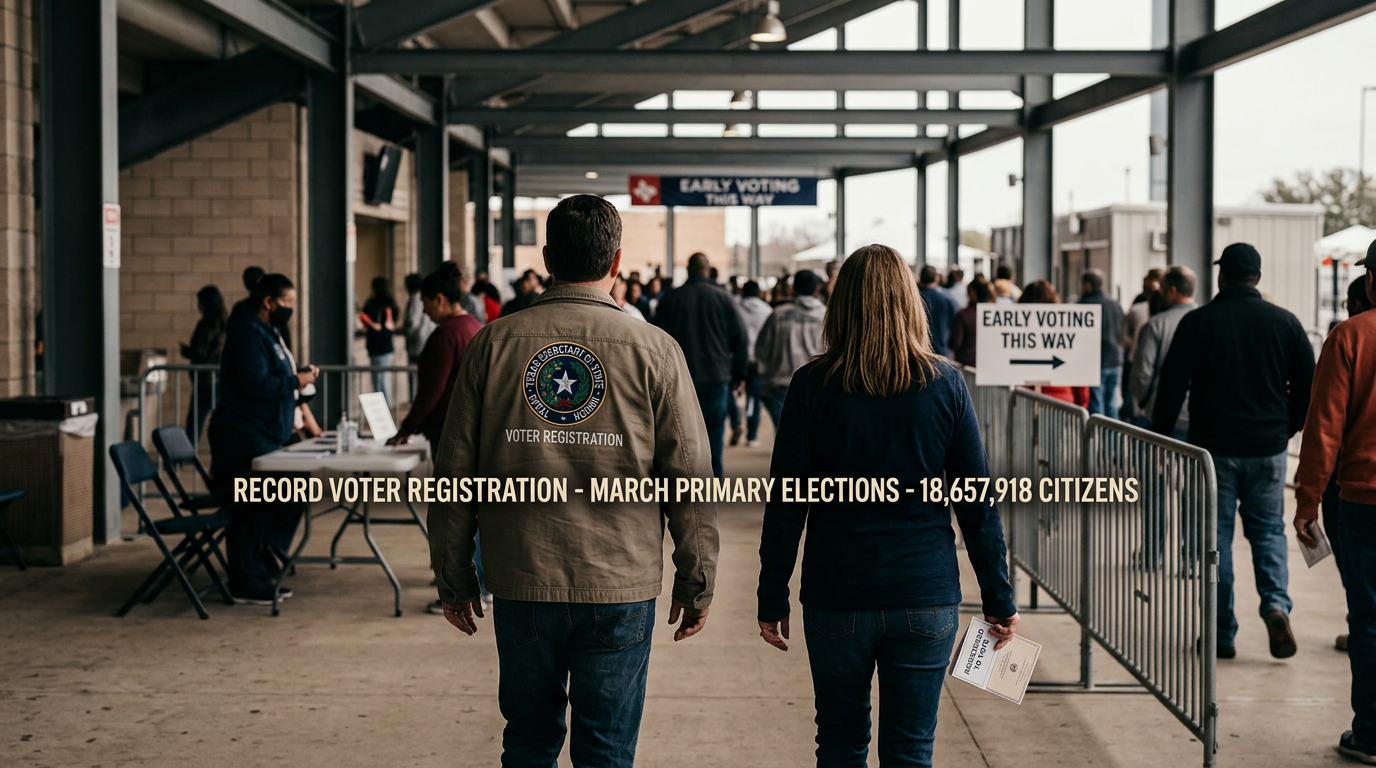
Texas Secretary of State Jane Nelson has officially confirmed that the state has reached a significant milestone in civic engagement, with 18,657,918 citizens registered to vote for the upcoming March Primary Election. This announcement coincided with the commencement of the early voting period, highlighting the massive scale of the Texas electorate relative to previous cycles. The figures represent a steady climb in voter participation initiatives across the state's 254 counties, reflecting both population growth and intensified mobilization efforts by political parties and non-partisan organizations alike. Historically, Texas voter registration has trailed behind the state's rapid population influx, but recent years have seen a narrowing of that gap. In previous decades, registration numbers often languished as the state transitioned through various demographic shifts. However, current data suggests that the administrative infrastructure managed by the Secretary of State’s office has adapted to meet the demand of a state that is now home to nearly 30 million people. This record-breaking total of over 18.6 million voters sets the stage for a primary cycle that will determine the direction of the state's legislative and congressional leadership.
Texas relevance
The impact of these registration numbers is felt most acutely in Texas's high-growth urban and suburban areas, such as the Dallas-Fort Worth Metroplex, the Greater Houston area, and the Austin-San Antonio corridor. As the state remains one of the fastest-growing in the nation, the surge in registered voters ensures that Texas maintains a dominant position in the national political landscape. Local election officials in counties like Harris, Tarrant, and Bexar are now tasked with managing record volumes of ballots, making the Secretary of State’s oversight and resource allocation more critical than ever for maintaining election integrity and efficiency.
A Shift in Electorate Demographics
The modern Texas electorate is vastly different from that of twenty years ago. With nearly 19 million people on the rolls, the state has transitioned toward a more diverse and mobile population. Many of these new registrants are young people reaching voting age or individuals who have relocated to Texas for its booming economy and business-friendly environment. This shift creates a dynamic where candidates must appeal to a broader spectrum of concerns, from traditional energy policy to modern infrastructure and technology investment.
The Secretary of State's office has noted that the increase is not localized to any single region. Instead, there is a pervasive rise in participation across the state’s rural heartlands and its bustling metropolitan centers. This widespread engagement suggests that Texans are increasingly aware of the weight their votes carry in determining state-level policies that affect daily life, ranging from property tax reform to border security and educational funding.
Administrative Challenges and Scale
Managing over 18.6 million registration records is a massive logistical undertaking overseen by the Texas Secretary of State in coordination with 254 individual county tax assessor-collectors. Each record must be verified for eligibility, and lists must be regularly maintained to remove individuals who have moved out of state or are otherwise disqualified. The announcement by Secretary Nelson underscores the success of the state’s centralized voter registration database, which allows for smoother transitions when voters move between Texas counties.
The scale of this operation is also reflected in the staffing requirements for polling locations. With such high registration numbers, county officials must ensure they have sufficient machines and personnel to handle potential surges during the early voting window and on Election Day. This requires significant coordination and financial investment from both state and local governments to prevent long wait times and ensure that every legally cast vote is accurately counted and processed according to the Texas Election Code.
The Role of Early Voting in Texas
Early voting has become a cornerstone of the Texas election process, often accounting for a significant majority of the total votes cast in major primaries. By releasing these registration numbers at the start of the early voting period, Secretary Nelson highlights the window of opportunity available to Texans to cast their ballots at their convenience. This two-week period is essential for managing the flow of the millions of registered voters, preventing the 'bottleneck' effect that can occur when the majority of people wait until the final day.
Furthermore, early voting allows for more robust auditing and observation practices. Parties and advocacy groups utilize this time to track turnout trends among their registered bases, adjusting their get-out-the-vote efforts in real-time. For the 18.6 million registered voters, the accessibility of various polling locations within their home counties provides a level of flexibility that is necessary for a workforce as large and diverse as that of Texas.
Impact on Primary Competitiveness
In a state where many offices are effectively decided during the primary stage, these registration figures are a harbinger of high-stakes competition within party ranks. The primary process serves as the gatekeeper for the general election, and with a record number of participants, the mandate for the winners becomes significantly stronger. Candidates are now forced to operate at a higher level of professional campaign management to reach such a expansive audience across various media markets.
The increased registration also means that grassroots movements have a larger pool of potential volunteers and donors. For conservative leadership in Texas, these numbers represent an opportunity to solidify the state's policy direction by engaging with a population that is clearly interested in the outcome of their governance. As the March Primary approaches, the focus moves from registration to mobilization, as the Secretary of State provides the foundation upon which these democratic exercises are built.
Technological Milestones and Future Outlook
The growth to 18.7 million registered voters is also a testament to the technological upgrades implemented within the Secretary of State's office over the last several years. Improved online resources for checking registration status and finding polling locations have made it easier for the average citizen to stay informed. These digital tools are essential for managing an electorate of this magnitude, providing a layer of transparency and accessibility that was previously difficult to achieve through traditional paper-based systems.
Looking forward, experts anticipate that Texas will continue to see these numbers climb as the general election approaches in November. The primary serves as an essential 'dry run' for the state's administrative machinery, allowing officials to identify any areas of the registration or voting process that may need refinement before the eyes of the entire country turn to Texas for the presidential cycle. The current figures establish a new benchmark for civic participation in the Lone Star State.
Analysis
The sheer volume of registered voters indicates that Texas is entering a period of unprecedented political activity. While high registration does not always guarantee high turnout, the fact that these numbers were released at the start of early voting serves as a strategic reminder to the electorate. From a conservative perspective, a larger, more engaged pool of registered voters emphasizes the importance of grassroots organizing and robust candidate messaging to ensure that the core values of the state are preserved in a rapidly changing demographic environment. The growth in registration also validates the state's efforts to maintain clear and accessible registration pathways while simultaneously enforcing security protocols.
Source attribution
This story was reported using a public release from the Texas Secretary of State. Keep TX Red rewrote the coverage independently and links to the official statement for verification.
Frequently Asked Questions
- How do I check if I am part of the 18.6 million registered voters?
- Texans can verify their registration status through the 'Am I Registered?' portal on the Texas Secretary of State’s official website. You will typically need your Voter Unique Identifier (VUID) or your Texas Driver’s License number and date of birth to access your record.
- What do I need to bring to the polls during early voting?
- Under Texas law, voters are required to present one of the seven acceptable forms of photo identification. These include a Texas Driver’s License, a Texas Election Identification Certificate, a Texas Personal Identification Card, a Texas Handgun License, a U.S. Military Identification Card containing your photograph, a U.S. Citizenship Certificate with your photograph, or a U.S. Passport.
- Can I register to vote during the early voting period?
- No. In Texas, the deadline to register to vote for a specific election is typically 30 days before Election Day. Those not currently registered will not be able to participate in the March Primary but may still register for future local or general elections.
- Where can I find my early voting polling location?
- Polling locations are determined by your county of residence. Most counties provide a list of early voting sites on their official election websites. Unlike Election Day, where you may be required to vote in your specific precinct (depending on the county), many Texas counties allow you to vote at any designated early voting site within your county.
Official Sources
Take the next step
Browse the Newsroom →Read more about Keep Texas Red → Our full guide to what Keep Texas Red means and why Texans support it.
Get Texas updates delivered weekly.
Independent Texas reporting on politics, policy, and daily life. One email a week. Unsubscribe anytime.
Keep TX Red Newsroom
The Keep Texas Red Editorial Staff produces nonpartisan explainers, policy breakdowns, and educational resources to help Texans understand how their government works. All content is reviewed for accuracy and updated regularly.
About Keep TX Red →